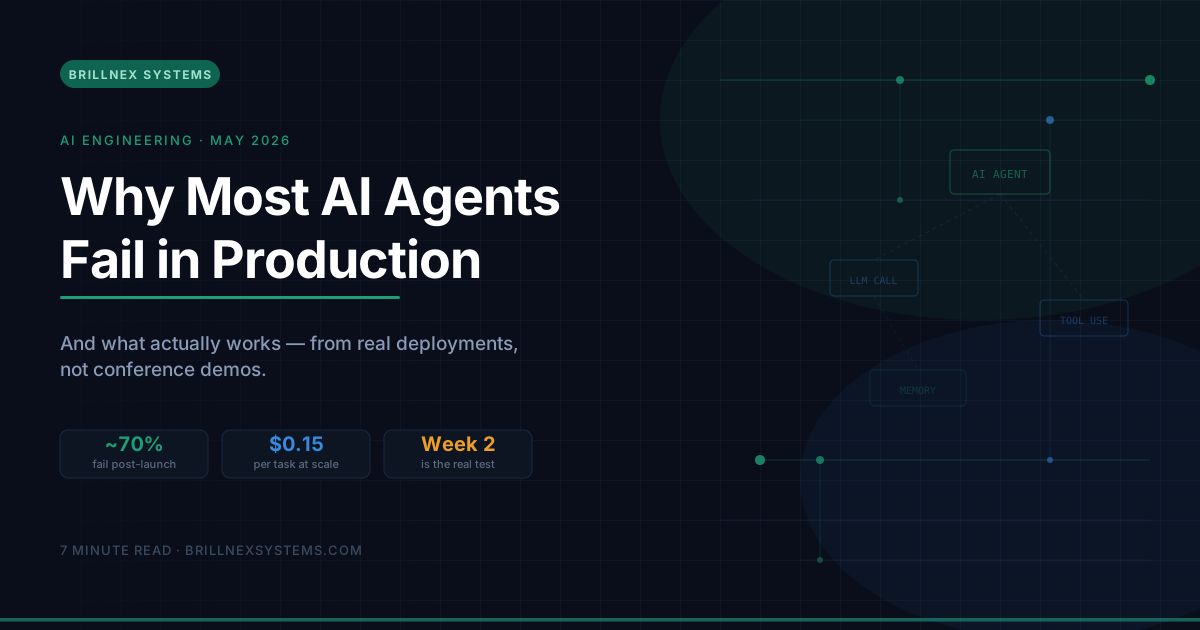
Everyone's deploying AI agents. Not everyone's keeping them alive past week two.
If you've been following the conversation in developer communities lately, you'll notice a sharp shift in tone. The "AI will change everything" hype posts are getting less traction. What's catching fire instead are the brutally honest threads: agents that burn through tokens without producing results, silent failures no one catches until the bill arrives, multi-agent pipelines that look brilliant in a demo and collapse in production. The Reddit consensus in May 2026 is blunt — the AI-agent market has moved from broad fascination to operator scrutiny.
At Brillnex Systems, we've been in the trenches integrating AI into real business workflows for startups and enterprises alike. This post is a no-fluff breakdown of why most AI agent deployments fail, which patterns actually survive production, and what your business needs to get right before going live.
The Problem Nobody Talks About at Conferences
Demo environments are lying to you.
In a controlled setting, an AI agent looks elegant. You feed it a well-structured prompt, it calls the right tools, returns a clean result. In production, the inputs are messy, the edge cases are endless, and the agent quietly fails in ways that don't throw errors — they just cost you money and erode user trust.
The most common failure modes we see:
Silent token waste. An agent enters a reasoning loop, burns thousands of tokens working through a problem, and either returns a low-confidence answer or times out. No error. No alert. Just a larger API bill and a user who got nothing useful.
Cache rebuild penalties. Teams optimizing for cost ignore how frequently context windows are being rebuilt from scratch on similar queries. The savings they expect never materialize.
Orchestration vanity. Multi-agent architectures look sophisticated on architecture diagrams. But complexity without necessity is a liability. The agents making real money in production right now are, as one blunt Reddit thread put it, "small, narrow, and boring" — email-to-CRM automation, FAQ support, resume parsing, content moderation. They do one thing extremely well, not twelve things acceptably.
Lack of human-in-the-loop design. Agents with production-level database or API access, operating without guardrails or escalation paths, are one bad input away from a serious incident. This is the failure mode that's generating the most discussion right now — and rightly so.
What "Production-Ready" Actually Means
When a client comes to us wanting to "add AI agents" to their product, the first question we ask is: what does success look like at week eight, not week one?
A production-ready AI agent isn't just one that works — it's one that fails gracefully, can be observed and debugged, and has a cost model that makes business sense at scale. Here's what that looks like in practice:
1. Narrow Scope, Deep Reliability
The temptation is to build agents that can do everything. Resist it. The highest-performing deployments we've worked on are agents with a single, well-defined job: schedule a follow-up, extract structured data from an invoice, route a support ticket based on intent, generate a first draft from a template.
When scope is narrow, you can test exhaustively. You can define what "correct" looks like. You can monitor for drift. That's how you build something that still works six months after launch.
2. Observability First
If you can't see what your agent is doing, you don't have a product — you have a black box with an API. Every production deployment needs:
- Token usage tracking per task type
- Latency monitoring with alerting on regression
- Confidence scoring where applicable
- A log of every tool call the agent makes
This sounds obvious, but the majority of rushed agent deployments skip it entirely and only realize the gap when something goes wrong.
3. Human-in-the-Loop for High-Stakes Actions
Not every agent action needs human review. But the ones that touch money, customer data, external APIs, or irreversible state changes absolutely do. Design your escalation paths before you build your agent logic — not after.
A practical pattern: agents that can recommend and draft, but require human confirmation before executing anything that can't be undone. This isn't a limitation — it's a feature your clients will trust.
4. Cost Architecture Upfront
One of the most eye-opening conversations we have with clients is about real per-task costs. A workflow that costs $0.15 per customer interaction sounds cheap until you're doing 50,000 interactions a month. Model it out before you commit to an architecture.
The levers that actually move costs: model selection (not every task needs the most powerful model), prompt compression, batching where latency allows, and aggressive caching of deterministic context.
The Patterns That Are Actually Winning
Based on what's working in production deployments right now — both from our own work and from the broader developer community — here are the agent patterns with the best track record:
Retrieval-Augmented Generation (RAG) with human correction loops. Agents that can cite sources and allow domain experts to flag errors directly on the output. This is particularly powerful in legal, medical, and compliance contexts where accuracy is non-negotiable and hallucination is catastrophic. The correction data improves the system over time.
Narrow automation replacing brittle RPA. Legacy robotic process automation (RPA) tools are fragile — they break when a UI changes, require constant maintenance, and struggle with unstructured input. AI agents that use accessibility-tree observation and exception queues are quietly replacing entire categories of RPA workflows, particularly in enterprise back-office settings.
Intent routing as the first layer. Rather than a single powerful agent trying to handle everything, a lightweight classifier at the front routes tasks to specialized agents. This keeps each agent's scope narrow, reduces cost, and makes failures easier to isolate and fix.
Async, non-blocking agents for non-urgent tasks. Not everything needs a real-time response. Agents handling report generation, data enrichment, or content drafting can run asynchronously, which dramatically reduces per-task cost and removes latency pressure from the critical path.
What This Means for Your Business
If you're a startup or growing business evaluating AI agent integration, the strategic question isn't "which AI tool should we buy?" It's: where in our workflow does automation create the most durable value, and what does a responsible deployment look like?
The companies winning with AI agents right now aren't the ones who moved fastest. They're the ones who moved thoughtfully — who scoped tightly, instrumented properly, and built for the long run.
That's the work we do at Brillnex Systems. We're not here to sell you a flashy demo. We're here to help you build AI integrations that still work — and still make business sense — six months after launch.
Final Thought
The Reddit conversation has matured. The questions being asked now aren't "is this possible?" — they're "which agents are economical, which survive week two, how should memory work, and what does good tooling look like above the base models?"
Those are exactly the right questions. And they're the ones worth answering before you deploy, not after.
If you're thinking about integrating AI agents into your product or internal workflows and want to do it properly, let's talk.
Brillnex Systems builds custom AI solutions, SaaS products, and software for startups and businesses — at offshore rates, with senior engineers based in Karachi. We specialize in AI integration that works in production, not just in demos.
Tags: AI agents, AI integration, production AI, SaaS development, custom software, LLM deployment, startup tech, machine learning operations